Check out the 1958 video we just put up on YouTube:
http://youtu.be/kXfFhmDWCNE
Sunday, November 18, 2012


Elmer Eger and the Floating Garage
Dan Jackson says, “After Hurricane Katrina in 2005 I spoke to Elmer about the 1936 flood that his family experienced. This piece is his response.”
The Floating Garage – a 2005 letter from Elmer Eger to Dan Jackson
St. Patrick's day was yesterday and it reminded me of the great 1936 St. Patrick's Day flood. We were living in a new home during the middle of the great depression. (Everything in my generation seems to have been great: the great war, the great depression, etc.). Our home was located on Neville Island, a strip of land about 10 miles southwest of Pittsburgh. The "Island" seven miles long and one half mile wide at its widest point and was a mixture of farming and industry. At one time it was and was purported to be richest township in the USA because of the taxes paid by more than 50 major industries, including Gulf Oil, Dravo Corporation, Pittsburgh Des Moines Steel, and on and on.
We were living in a new home only because it was practically given to my father ($25.00 per month with every payment going toward purchase) by his good friend and business neighbor Ernest Harper, who had built the house for speculation before the depression took hold. The house did have a deficit. There were not enough electric receptacles in the living room and in order to enjoy the radio and enough lamps, my father ingeniously drilled through the floor and plugged the radio into a receptacle in the basement. As you will see that was a fateful act that later was almost disasterous.
Dad passed away suddenly in July of 1935 and my Uncle Sam and Aunt Sarah Sharp came to live with us. One reason was to share the expenses and the other was for Aunt Sarah to keep house while my Mother went to business. Mother and Dad had just started a jewelry shop a year earlier and my mom to her everlasting credit was determined to keep it going. She struggled mightily, educated two children and lived to see her efforts blossom into a thriving business many years later.
The winter of 35-36 was severe, with snow and ice piled everywhere especially in the upland watershed of north western Pennsylvania. In March a sudden thaw released untold amounts of water and ice floes into the Allegheny and Monongahela rivers which joined to form the Ohio River at the famous Golden Triangle of the city of Pittsburgh. It was the first year in many years that the three rivers has frozen solid and if it were not for the heavy paddlewheel and barge traffic which forged a channel in the ice one could have easily walked from shore to shore.
With the spring thaw the river flowed with huge chunks of ice. As the river rose our cellar began to flood. We carefully unplugged all of the electrical appliances in the basement including dad's radio connection. So having no communication with the outside world and trusting that a flooded basement would be the only eventuality, we all went to bed.
At three AM that morning my Aunt roused us and told us to dress quickly because the water was up to top step on the front porch and would soon be in seeping into the first floor of the house. My uncle's 1931 model A ford was in the garage and by now the water was over the running board and possibly into the motor. Anyway there was no way to drive it out in over 2 feet of water. Somehow my mother, sister, aunt and uncle and I waded through small ice flows about 500 yards to the main road which was fortunately built on a hog back and was several feet higher than Yale Avenue the little street where our house stood surrounded by icy water. There on the main spine of Neville Island, we were met by a taxi which had come across the bridge and braved the road which was threatened from both sides by the rising rivers. Thanks to that brave cabby we crossed safely to the mainland of Coraopolis and were deposited at the Jewelry shop which was dry and warm and a safe haven at least for the time being. At dawn we learned that the water was still rising and several homes in the lower end town were already flooded. It was an awesome sight to a young teen because there were boats on some of the streets. As people gathered on the Main street the wisdom was that the water would never reach 4th Avenue one of the two main arteries through the town and the water reaching 5th Ave a block up the hill was not even a possibility. But it did. It reached fifth Avenue, which meant that it put 4 feet of into the the Jewelry store which had becoume our temporary haven. Miraculusly the water stopped short of the shelves on which we had piled the store merchandise. Fortunately at nine that morning I had taken a couple of cartons of rings and watches and valuable jewelry to the Bank Vault of the National Bank which was spared from by the rising waters.
After a short period of bemoaning our fate and being taken in by kind neighbors and wonderful relatives in Aliquippa, everyone waited for the flood to recede, which it did much more quickly than it came.
As can be expected the flood reeked havoc doing millions of dollars worth of damage and leaving in its wake mud and oil and every mess that one can imagine to be cleaned. But cleaned it was and there were and are a million stories in its wake. One family would have been content to clean out the mud and debris but an oil drum had cracked open on a telephone pole spilling the oil and when the water went down their walls and floors were coated with oil. How that house was restored I will never know. I myself, started the coal furnace with our dining room table--that same table that I had been scolded for using as a ping-pong table not too many months earlier.
Remember Uncle Sam's Ford? It was housed in a wooden garage which had a wooden floor. The floodwaters picked up the garage with the Ford still in it and floated it for ½ mile where it miraculously came to rest against an oil derrick, the last obstacle on the island's tip. There it was lowered gently to the ground right side up as the water receded. Eventually the car was towed to a garage where Uncle Sam expected to junk it. And what was he to do? No one carried flood insurance and he certainly couldn't afford a new car. A mechanic suggested that they blowout the gas lines and refill the tank. Nothing to lose. Lo an behold the car after a couple of coughs started right up and ran nicely for a couple years to come. Try that with one of our computerized engines in today's automobiles.
As I edit this we are six weeks past Hurricane Katrina which wiped out New Orleans and much of the Gulf Coast. As I watch the tragedies of hurricanes, floods, fires and sunamis, and as I watch families being wiped out I know from personal experience that the chances are good that the victims will remake a good life for themselves. I think the human spirit is as resilient as Uncle Sam's Ford. Blowout the gas lines and give it another whirl.
Monday, October 22, 2012
Letter to Arlen Specter
In 1992 I got a flyer from Arlen Specter, aimed at Jews, describing what a wonderful Jew he was and why I should support him. Sandy saved the flyer and my heated response that he was a bastard.
The flyer he sent out was his plea for his reelection. Why did he send one to me in Texas? Beats me.
Here's the letter he sent me:
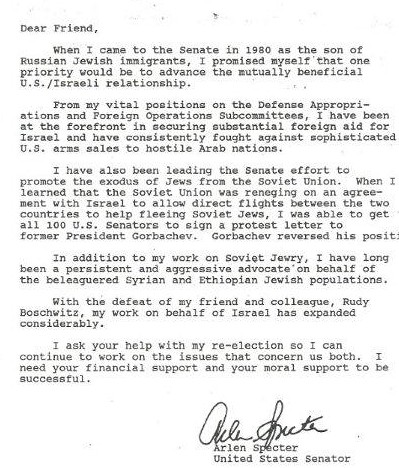
And here's my response:
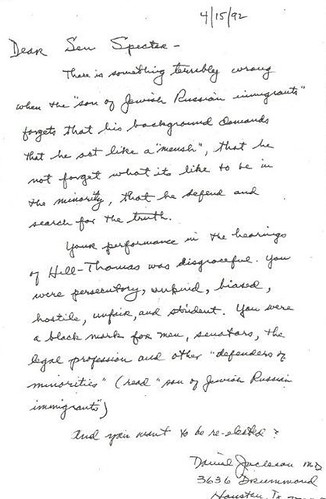
4/15/92
Dear Sen Specter -
There is something terribly wrong when the "son of Jewish Russian immigrants" forgets that his background demands that he act like a "mensh", that he not forget what it's like to be in the minority, that he defend and search for the truth.
Your performance in the hearings of Hill-Thomas was disgraceful. You were persecutory, unkind, biased, hostile, unfair, and strident. You were a black mark for men, senators, the legal profession and other "defenders of minorities" (read "son of Jewish Russian immigrants").
And you want to be re-elected?
Daniel Jackson MD
The flyer he sent out was his plea for his reelection. Why did he send one to me in Texas? Beats me.
Here's the letter he sent me:
And here's my response:
4/15/92
Dear Sen Specter -
There is something terribly wrong when the "son of Jewish Russian immigrants" forgets that his background demands that he act like a "mensh", that he not forget what it's like to be in the minority, that he defend and search for the truth.
Your performance in the hearings of Hill-Thomas was disgraceful. You were persecutory, unkind, biased, hostile, unfair, and strident. You were a black mark for men, senators, the legal profession and other "defenders of minorities" (read "son of Jewish Russian immigrants").
And you want to be re-elected?
Daniel Jackson MD
Wednesday, August 8, 2012
Sunday, January 15, 2012
It’s the Culture, Grampa
Bryan and I were at our weekly breakfast at La Madelaine in the Galleria. As usual, he had quiche and coffee and I had toast and coffee. When we finished our second cups, I asked if there was anything he wanted to buy. He said there was a card shop on the second floor of Galleria 2 where he wanted to look for something; just the place for a sixteen year-old.
While he shopped, I watched the cashier. She was a teen-ager, thin, dressed in a dark blouse and pants. She was not attractive, a state made worse by uncombed hair and her failure to smile. And her tattoos, around her neck and her wrists, shocked me. They were green and irregular, looking like colored barbed wire. What in the world had she done to herself?
As we walked out the door, I asked Bryan if he had noticed the tattoos. He said he had. I asked how he felt about them. He shrugged his shoulders. I told him I thought they were ugly and predicted that when she grew up to be a young lady, she would be sorry that she had disfigured her body and would not be able to reverse the damage except at great cost and pain.
Demonstrating wisdom beyond his years, he set me straight, “It’s the culture, Grampa.” He was telling me that my view of tattooing lagged far behind the changes that were going on around me. This had nothing to do with Maori natives and the natives of Papua New Guinea and professional wrestlers and basketball and football players with colorful decorations on their bodies. This was a teenager who looked upon tattooing as part of her makeup like lipstick or a piece of jewelry or hairdo except that it was permanent.
I began to be more aware of body art---a leaf on the ankle, a butterfly on the shoulder, an arrow on the small of the back, a heart on the side of the neck. I viewed them as cute, still limited to the young and daring. But would members of the upper crust, the wealthy, the powerful do this to their bodies? The answer came in a profile in the October 21, 2011 issue of The New Yorker of Jill Abramson, the newly appointed editor of The New York Times. She confessed that at one time when she had been transferred from her beloved New York to California to a new position, she had a tattoo of a subway token, “good for one trip” inked on her body. She won’t tell where it is; no matter, tattooing has arrived and is definitely part of our culture.
Tuesday, December 6, 2011
Coming to America
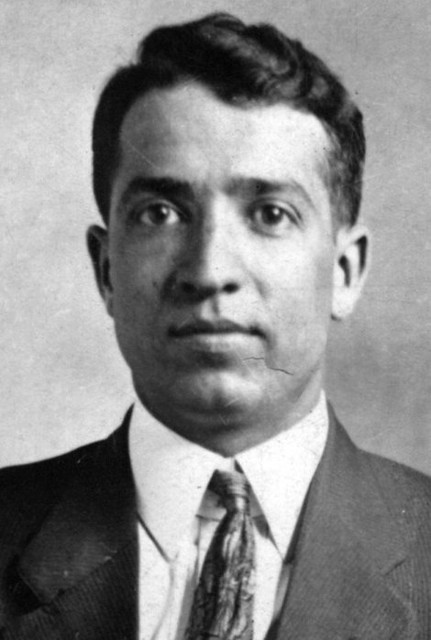
Dad was an incurable romantic. He loved to tell Evy and me stories of his childhood in Kurenetz, Russia, of his attempts to leave home to come to America, and of his early experiences in his adopted land. Those stories are part of our childhood as well as part of Dad’s being a father and a historian and a story teller. Some of his tales differed between what he told us and what he said later in his oral history. Both version are delightful and worth recounting.
Listen to what he told us about the Gypsy with whom he became friendly on the Prince Oskar, the ship that brought Dad to America. The Gypsy’s family was unaccustomed to sailing and much of the time was plagued with sea-sickness. Their worst trauma was the lingering illness and death of their youngest child. Dad was pained by their loss and did his best to comfort them especially because none of the other passengers in steerage gave any attention to them in their grief.
When the Prince Oskar docked at Philadelphia, Dad was told he could not land unless he had $25 in his possession. It was presumably to prevent his becoming dependent on the social services of his new country. It was actually a ploy of the anti-immigrant feeling brought on by the influx of immigrants from Eastern Europe. Dad told the authorities he was penniless; where could he get $25? The immigration officer warned him that if he didn’t have the money, he would be put on the next ship returning to Hamburg, the port that he had come from. Dad was frantic; how could he, a poor man in a new country, get $25? It was his good friend, the Gypsy, who stepped in and gave him the $25. Dad was overjoyed; he assured his savior he would get the money back to him somehow.
The story did not end there. One morning many years later, when Dad was sweeping the sidewalk in front of the shoe store, he looked up and there, on Franklin Avenue, was the Gypsy and his family traveling along by horse and wagon. Dad hailed them and they talked for a while. I can’t remember for certain, but my guess is that Dad paid him back the $25. It would certainly round out a remarkable tale.
But there is a different version of the $25 in Dad’s oral history. Yes, the authorities did demand that he have $25 on his person before they would allow him to land, but there the story takes a different turn. When he did not have the money, he and several others in similar straits were taken by a small boat to an island in Philadelphia harbor, there to wait until they could produce the money. If not, they would be returned across the Atlantic. As Dad glumly pondered his ill-fate, “a man with a jacket with brass buttons” spoke to him in Yiddish! “Why are you so unhappy,” he asked. Dad explained the money problem. The man gave him the money and told him not to worry. He explained that he was from HIAS—Hebrew Immigrant Aid Society—and he was there to help. Dad had heard about HIAS back in Russia and now knew that his arrival in America was secure.
It wasn’t the Gypsy who had come to his rescue. He was real and kind and friendly but did he rescue Dad in his moment of financial need? Or was it HIAS which was part of the welcoming agencies to help and protect immigrants.
There is another story that we heard Dad tell over and over. When I say that I remember hearing his stories, I am also aware that I could tell when he was about to tell one I had heard before but I never wanted him to stop. I remembered the stories, having heard them so many times but I wanted to hear them again.
The story of the change of Dad’s name from the Russian to the American form was one we heard so often that it seemed like a fairy tale with a highly pleasing ending. When the immigration officer asked Dad his name, he told him “Hillel Yachnovich”. According to Dad, the officer said it wasn’t American enough. Dad then said, “My brother’s name is Louis Jackson.” That caught the officer’s fancy who announced that Dad’s new name was now Harry Jackson.
I have been told, on good authority, that at one time it was legal (and common) for immigration officers to change an immigrant’s name if the officer thought it too hard to understand or pronounce or if it was not “American” enough. It could even be changed if the immigrant so requested. Dad told Evy and me that story so many times; we were fascinated that Dad’s quick thinking had given him his new name and paved his way past the port’s authorities.
Dad’s oral history has a different version which certainly makes more sense. Dad retained his name through the immigration process. When he was permitted to, he went to Munhall, a steel mill town near Pittsburgh to find his brother Louis who was the first Jackson brother to come to America. There, Dad joined other immigrants, men and women who were determined to become American as soon as possible. They formed social groups to learn to speak better English by reading poetry and prose, by putting on plays, by debating, and singing, solo or in groups. On attending his social group one evening, Dad learned that without consulting him the group had decided that he should change his name from Hillel Yachnovich to Harry Jackson. He was crushed that he had lost “Hillel” the name of a famous rabbi and scholar, and “Yachnovich”, the name of his father, whom he venerated and respected. He was heartsick but kept his feelings to himself and gradually accepted the change to his American name. So, if it is true that his social group changed his name for him, then the story about it being changed by an immigration officer, as he told us over and over, was just more evidence of his love of spinning a lively tale with a happy ending.
In his reflections about the new name that had unceremoniously been attached to him by his fellow-immigrants, he confessed that he had submitted to their action without open objection because long since arriving in America, he had been thinking that “Yachnovich” sounded too Russian for someone who wanted to be Americanized as quickly as possible. He knew he needed to make a change. As he turned the matter over and over in his mind, he could not find a sound in English to match the sound of the Russian “ch”; he had thought of “Yachnin” which his friends had trouble pronouncing. He discarded “Yanin” as sounding weak. He scolded himself for being unable to make a choice in the matter, finally gave in to his social group’s summary decision, and adjusted to being “Harry Jackson” for the rest of his life.
Monday, August 29, 2011
Mother and the Glass Ceiling
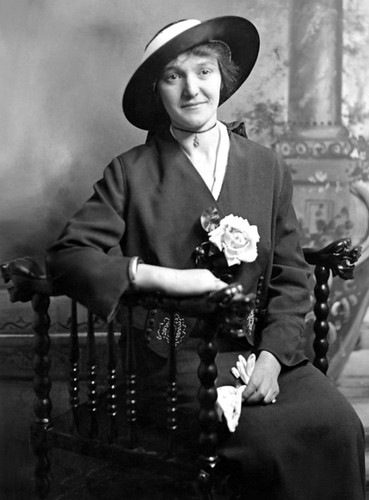
Dad always wanted to be in business for himself. In May 1925 he took the plunge and bought a bankrupt shoe store in Woodlawn, Pennsylvania and changed its name from Economy Shoe Store to Jackson’s Shoe Store. Uncle Morris became his partner and soon hard work and good business sense turned Jackson’s Shoe Store into the busiest shoe store in town. Dad needed help; he asked Mother to come work at the store. She didn’t have to go with him when he opened the store at 6 a.m. but after she had tended to the maid and Evy and me, she could go down late morning. Mother enjoyed the work, liked waiting on women customers, found the work preferable to being a stay-at-home mom whose other times out of the apartment were for bridge parties, visiting her sister, Mollie, or going to Kaufmann’s in Pittsburgh to shop.
At the end of her first week at work when Uncle Morris handed out pay checks, Mother asked for hers. He snapped, “Family doesn’t get paid.”
Mother let him know how she felt about that; “I work here, you pay me.” She had been so valuable as a saleslady, they knew they couldn’t afford to lose her. They paid her.
That was not the first time Mother had asserted herself. When she and Dad were courting, she decided she wanted to marry him. As she tells it, when the family was together, she gave them the news. They refused to hear of it: no, he was not the one for her. He was a greenhorn—a derogatory term for immigrants who had not become “Americans”—he couldn’t speak good English. He was not good enough for her.
As she tells it, she rose to her feet and made it clear, “I am going to marry him and you are going to give me a wedding!” And she married him and they gave her the wedding.
In the shoe store Mother’s skills blossomed. She connected well with her women customers. They wanted shoes to make their feet look small but that made their feet hurt. She persuaded them to buy stylish shoes in sizes a little longer but a little narrower that would be comfortable and still not look too long. She took correspondence courses from Dr. Scholl to learn how to fit arch supports, the precursor of today’s orthotics. She convinced the store to offer dyeing fabric shoes so young women could have shoes that matched their gowns without the expense of buying new shoes. She contacted dance teachers in town to announce that Jackson’s would order Capezio ballet slippers for their students. And she went with Dad to shoe shows to help him select shoe styles for each coming season’s inventory.
Mother, the first and maybe the only feminist in the family, knew her worth long before the cry, “Equal pay for equal work.” I don’t think Mother wanted to start a campaign to push for women’s rights; she was just claiming rights for herself. She showed she had skills beyond being a wife and mother and baleboste (an excellent homemaker) and could enter a man’s world and do as well as any of them. She wanted to be recognized for her ability and wanted to be paid as well. True, Aunt Jennie, her sister, worked with Uncle Lou in their variety store, and if the jewelry store Aunt Sarah and Uncle Herman owned was open, Aunt Sarah could always be seen there. I don’t think either wife was on the payroll.
I asked Bea Miler if her mother, Aunt Sarah, was a paid employee. She answered, “Good question. I don't think so, but couldn't swear to it. I never got paid for cleaning the silver, stamping wallets, putting stock away, taking payments at the window (credit jewelers), or taking repairs into Pittsburgh twice a week in the summer, Saturdays in school months. It's one of those questions you don't think of until there's no one left to answer it.”
Mother made her way in a family controlled by men by meeting the challenge head on. She demanded her place in the family and business world and proved she could compete with the best of them. I admire her.
Tuesday, August 2, 2011
From Zuckerman to Yachnovich to Jackson
Or "How did you get the name Jackson?"
Esther and Hillel Zuckerman were the grandparents of my father, Harry Jackson. In fact, my father was named Hillel Tzvee after his grandfather. They lived in Berezino, a shtetl in Minsk Province (Minska gubernia) in Belarus or “White Russia”. When Hillel died, Esther moved on, fearful that her two children might be snatched up, drafted, for twenty five years by the Russian army. She ended up in Kurenets where she changed her name to Yachnovich, a name that sounded less Jewish and more Russian, a ploy she thought would put the army off the track. Yachna, her mother’s name, was the inspiration for the change.
According to the family tree, Esther’s son, Moishe Zuckerman Yachnovich married Doba and they raised eleven children which included five sons, four of whom will immigrate to America to avoid the Russian draft and to search for a better life. Those four Yachnovich sons, Louis, Joseph, Harry, and Sam will become Jacksons. So, how did that come about?
That’s easy to explain about Joseph and Sam---they simply took the name Jackson that Louis and Harry who preceded them had already changed to. But the changes by Louis and Harry become the stuff of romance and family myths.
Let’s start with Louis. Dad says Louis’s name was changed to Jackson by an immigration officer at Ellis Island who told Louis that Yachnovich was too hard to pronounce or didn’t sound American. That action was legal at that time and there are enough stories by immigrants to believe that that actually happened. However, another family member checked the immigration records and found 1) no evidence of a name change at Ellis Island and 2) after Louis had been in America for a short time, he applied for a name change at an immigration office somewhere in the Pittsburgh area. So much for Dad’s version.
Now Dad explains his name change. He told me and Evy that at the Philadelphia port, the immigration officer told him that Hillel Yachnovich was not American enough. Dad explained that his brother was Louis Jackson. “Well” the officer said, “then your name is Harry Jackson.” But in his oral history Dad says that the social group he joined to help him with becoming an American decided they didn’t like his name and changed it for him. They didn’t consult him, and at first, he resented it. With time he got over the loss of Hillel Tzvee Yachvovich with its connections to his grandfather and the great sage and scholar and became Harry Jackson.
Thus, by the way of history, romance, and family myths the changes from Zuckerman to Jackson entered the family tree.
Esther and Hillel Zuckerman were the grandparents of my father, Harry Jackson. In fact, my father was named Hillel Tzvee after his grandfather. They lived in Berezino, a shtetl in Minsk Province (Minska gubernia) in Belarus or “White Russia”. When Hillel died, Esther moved on, fearful that her two children might be snatched up, drafted, for twenty five years by the Russian army. She ended up in Kurenets where she changed her name to Yachnovich, a name that sounded less Jewish and more Russian, a ploy she thought would put the army off the track. Yachna, her mother’s name, was the inspiration for the change.
According to the family tree, Esther’s son, Moishe Zuckerman Yachnovich married Doba and they raised eleven children which included five sons, four of whom will immigrate to America to avoid the Russian draft and to search for a better life. Those four Yachnovich sons, Louis, Joseph, Harry, and Sam will become Jacksons. So, how did that come about?
That’s easy to explain about Joseph and Sam---they simply took the name Jackson that Louis and Harry who preceded them had already changed to. But the changes by Louis and Harry become the stuff of romance and family myths.
Let’s start with Louis. Dad says Louis’s name was changed to Jackson by an immigration officer at Ellis Island who told Louis that Yachnovich was too hard to pronounce or didn’t sound American. That action was legal at that time and there are enough stories by immigrants to believe that that actually happened. However, another family member checked the immigration records and found 1) no evidence of a name change at Ellis Island and 2) after Louis had been in America for a short time, he applied for a name change at an immigration office somewhere in the Pittsburgh area. So much for Dad’s version.
Now Dad explains his name change. He told me and Evy that at the Philadelphia port, the immigration officer told him that Hillel Yachnovich was not American enough. Dad explained that his brother was Louis Jackson. “Well” the officer said, “then your name is Harry Jackson.” But in his oral history Dad says that the social group he joined to help him with becoming an American decided they didn’t like his name and changed it for him. They didn’t consult him, and at first, he resented it. With time he got over the loss of Hillel Tzvee Yachvovich with its connections to his grandfather and the great sage and scholar and became Harry Jackson.
Thus, by the way of history, romance, and family myths the changes from Zuckerman to Jackson entered the family tree.
Saturday, May 28, 2011
Medicine and Compassion
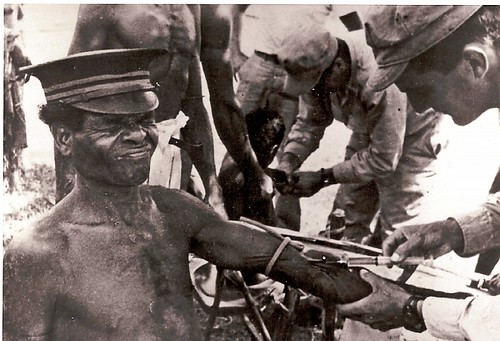
I first met Nate in 1944 in Papua New Guinea where I was a GMO(general medical officer with the 102nd Station Hospital. I was never very busy, so, when Nate, the flight surgeon from the nearby air base, invited me to go with him to check for medical problems at the native village, I was ready to go. Nate (Capt. Nathan Shlimovitz, later shortened to Shlim) took penicillin from the base dispensary to give to native children infected with yaws and to men with venereal disease. He had been there before; the natives were glad to see him and readily lined up for their penicillin. He was patient and never displayed any anger; he was always in a good humor. I enjoyed being with him.
When the war moved north, the 102nd closed down and we were absorbed into the 35th General Hospital at Lae. There I became a dermatologist; there was no challenge, so I volunteered for the Alamo Scouts. Now I found myself at the southern tip of Leyte in the Philippines as the medical officer for a unit devoted to gathering intelligence for the 6th Army. There was little to do; the officers and support personnel were in exceptionally good mental and physical shape.
After three months with the Scouts, I was transferred to the 58th Evac Hospital on another Philippine island, Cebu. The commanding officer sent me to the operating area to put the injured to sleep for surgeons to work on. It was all new to me and I enjoyed it immensely. I was never bored.
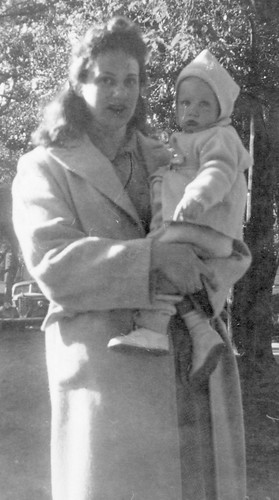
The next stop was Luzon where I ate, slept, read, and played volleyball; ten days after the armistice we landed by navy cruiser at Yokohama to set up our hospital. Now it was boring again; it helped that I explored bombed out, burned out Tokyo and went part way up Mt. Fuji. The truly exciting event was getting orders to go home. Yvette and 18 month old Fuzz met me at the railroad station in New Orleans on the morning of November 25th, 1945.
Back in the States, I began my postgraduate training with a residency in tuberculosis at Cleveland City Hospital in April 1946. I hoped that if my performance were good I would get a recommendation from the chief of the service that would improve my chances of getting a residency in internal medicine at the same hospital. I kept up my interest in internal medicine by attending rounds and lectures on internal medicine. One evening I went to a lecture at the Lakeside Hospital by Harry Goldblatt, a world-famous researcher on hypertension. I was a bit late and had to stand at the top row of the amphitheatre.
When the lecture was over and the crowd began to clear, I was surprised to see Nate across the hall. I went over to greet him and find what he was doing at the lecture. He was glad to see me, but all was not well. He was a resident in surgery and he and his wife, Sylvia, and infant, Harriet, had been renting a house near the hospital. Without warning, the owners had returned and demanded they leave. Nate had been struggling to find another place to live. If he failed, Sylvia and the baby would have to return to Chicago; he would be alone in Cleveland. I told him I would see what I could do. I was not optimistic because Yvette and I had experienced the same scenario—we had rented a home in the middle class section of Cleveland, and when the owners decided to cut their vacation short and wanted the house back, we had had to scramble to find a another place to live; luckily a slum apartment near the hospital opened up—we were glad to get it.
When I returned home after the lecture, I told Yvette of meeting Nate and hearing his awful story. Yvette’s solution was simple: they should move into our apartment with us. They stayed with us for six weeks until they found a place for themselves. Our apartment was small, two bedrooms, a kitchen, part of which was the bathroom, no appliances except an old range with a useless oven. They moved in. When Nate and I went to our work in the morning, Yvette and Sylvia cleaned up, tended to Richard and Harriet, all the while chatting like old friends. During the six weeks that we lived together we got along famously, nary an unkind word or disagreement. It helped that Sylvia was a gourmet cook.
We kept in touch. After the Shlims settled in Portland, Oregon, and we in Houston, we traveled with them to San Francisco and northern California. We visited them when we joined a group that left from Portland to go to China in 1977. And they surprised Yvette by showing up at her 70th birthday party in 1987. Being with them was fun though it was marred by Sylvia’s endless complaining that Nate insisted on buying apartment buildings and turned them over to her to manage. Nate pooh-poohed her complaints and continued to invest in apartment buildings.

Naturally, we asked about their children: Harriet was the infant who had lived with us for six weeks in Cleveland. They never talked about her. The second child was David, a physician. When we asked about him, both Nate and Sylvia mumbled something about a clinic in Katmandu, Nepal. That happened several times; the message was clear that they were not interested in talking about him. It was hard for Yvette and me to believe that the parents of a doctor would not want to talk about him, to boast about him.The youngest child was Larry who had hopes of breaking into the world of professional photography.
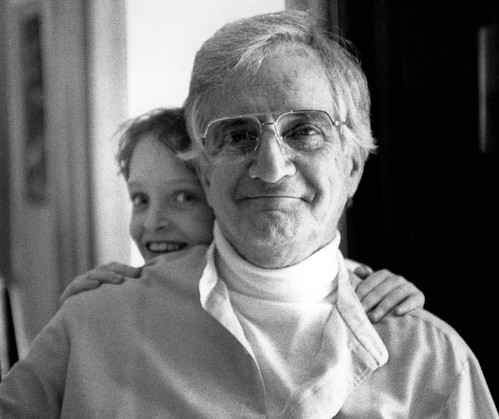
In 2009 Rob saw a note in the Smithsonian magazine announcing that David Shlim, M.D. had published a book. That night I phoned David, “David, this is Dr. Dan Jackson.”
There was a pause; then David began to chatter at a great rate. He remembered who I was. He had heard his parents talk about their experience in Cleveland in our apartment. He had given up the clinic at Katmandu and a job as an emergency room physician and had opened a solo practice near Jackson Hole, Wyoming. When I asked about his book, he explained: on one of his trips to Katmandu, a Buddhist priest had approached him and commented on the stress he saw in his face. He convinced David that he could help him. They began a series of conversations that lasted three years during which David learned about the need for compassion in his life. Over time he changed and was now much happier.
He had written a book about his experience, Medicine and Compassion: it was for doctors and their patients. He sent me a copy and a snapshot of the priest who had changed his life. He had inscribed on the title page: “To Dr. Jackson, who showed compassion to my parents in their time of great need.” That was a lovely gesture by David to me and, of course, to Yvette. I was pleased that he had done so much for himself, had turned his life around. My curiosity was tweaked: what had happened to David that had created so much stress in his life? I had the feeling that his stress was a reflection of his anger, anger that he carried within himself and chose to ignore rather than face. There were hints of that in his book but until he had met the Buddhist priest, he had avoided facing the truth.
If I had been able to talk with his siblings, Harriet and Larry, I might have been able to learn something about David as he was growing up. I remembered that Harriet, the infant who had stayed with us in Cleveland, had appeared in Houston out of the blue to visit us. She was having trouble in her marriage. Oddly, Harriet gave no explanation why she had not talked with Sylvia or Nate about her troubles. The youngest of the three children, Larry, had been with us on the trip to China. He kept to himself and as far as we could see, he made no friends; he stuck to taking pictures. When we visited the Shlims in their home, Larry appeared only at meals. Was this the picture of a dysfunctional family?
It would have helped if I had sat Nate and Sylvia down, figuratively shaken them, and demanded, “I want to know about David, tell me about him.” Out of those conversations I might have gleaned enough information to make an informed guess why David had become so angry, so alienated from his parents. Of course, none of that was available to me.
My pop psychology led me to believe that the relationship of David to his parents held the answer to my question about his stress. Of the two I would choose Nate as the one to focus on—he was the more forceful, the more demanding of the two. Sylvia had already told us how he ignored her when she grumbled about his buying the apartment buildings and Nate, a surgeon, was a member of a culture that marked him as one to be obeyed and not questioned.
How did Nate impact David’s life? Did Nate make it known, openly or subtly, that he expected David to be a doctor? Was he disappointed and angry that David refused to go into further training to become a surgeon like himself? Did David feel Nate’s anger and leave home to escape the conflict over his training? We know he had little contact with his parents: he spent six months out of the year on the other side of the world to work pro bono in the clinic in Katmandu, Nepal; when he ran out of money, he came home to Portland to work as an emergency room doctor to replenish his funds to be able to return to Nepal and again work in the clinic. Being at odds with his father and in too much inner turmoil to settle into a stable medical practice, he could see that his life was going nowhere. How could he get out of this pit of despair, not necessarily to please his father, but even please himself? He hated himself; he had disappointed everybody, especially himself.
We cannot be certain that we know why David had became so angry and stressed, but we do know that anger that is not dealt with leads to stress. It was fortunate that the Buddhist priest took it upon himself to point out that he could see on David’s face the reflection of the stress. David then embarked on conversations with him over the period of three years to learn about himself. He now feels better, is happy, likes himself, has learned that if he understands his anger, then he can understand others and be compassionate toward people around him. As a result of what he learned about himself, he spends only a small amount of his time as a physician. He travels, lectures, and talks to doctors and their families about what he has learned about being compassionate, about what it has done for him, and what it can do for them.
David’s learning to be compassionate struck a familiar note with me. When I was in training I began to form an image of how I would conduct myself in the presence of patients. My first contact with a patient would be in my consultation room; there would be a desk between us. I would address patients as Mister and Misses. I probably wouldn’t smile much; it might not be too wise to be too friendly. I would hide my emotions. I wouldn’t let anything upset me; at least I wouldn’t let on if I were upset. It would be important not to let the patient get too close to me: I would not be the patient’s friend, I would be his doctor; I must avoid being both. If a patient invited me to lunch, I’d find an excuse not to accept; that might put him too close with me which would influence my feelings about him.
If a patient were angry, I wouldn’t question his behavior, if he wanted to tell me what was upsetting him, I would wait for him to explain. I wouldn’t try to get any information from him; he’d have to speak without any direction from me. If a patient were to cry, I would provide a tissue; it never occurred to me to say I was sorry that he or she was so unhappy. I would avoid smiling. I would stick to the matter at hand, no small talk. I wanted to be a good, competent physician but not be friends with my patients. I had no idea that patients needed my humanity more than my examination and a prescription.
As time passed I sensed I needed to change. With help I learned that my patients wanted to talk and if I were quiet and were willing to let them talk, that would get me a lot of information. It would let patients know that I would listen to them and not ignore their feelings. I learned how it made a difference for me to see new patients in my examining room instead of my office. There would be no desk between us; they would sit on the examining table and I would sit on a stool and listen. I wanted to listen, to hear, to be a friendly ear as well as a professional one. I learned to care for my patients, I could call them by their first names, it would not hurt me to be close, and that really caring, being compassionate, would be good for both of us.
I don’t think I would be a happy physician in today’s practice; the patient is not allotted much time and my style of sitting and listening takes up a lot of time. If he takes up too much time, other patients will suffer or if they demand more time, I would have to extend my hours long after the usual 5:00 pm deadline. Most of all I would feel uncomfortable, knowing that I was shortchanging the patient, that I wasn’t giving him the time he needed to tell me all that was on his mind. I probably would retire completely from practice or find a desk job which I would hate. I’m lucky I retired before the changes in medical care occurred that would have forced me to make that decision. Now, instead of fighting a system of medical care that emphasizes speed and money, I read, I write, and I watch the squirrels and birds outside my study window. My medical life and my personal life have turned out well; I’m tickled pink.
When the war moved north, the 102nd closed down and we were absorbed into the 35th General Hospital at Lae. There I became a dermatologist; there was no challenge, so I volunteered for the Alamo Scouts. Now I found myself at the southern tip of Leyte in the Philippines as the medical officer for a unit devoted to gathering intelligence for the 6th Army. There was little to do; the officers and support personnel were in exceptionally good mental and physical shape.
After three months with the Scouts, I was transferred to the 58th Evac Hospital on another Philippine island, Cebu. The commanding officer sent me to the operating area to put the injured to sleep for surgeons to work on. It was all new to me and I enjoyed it immensely. I was never bored.
The next stop was Luzon where I ate, slept, read, and played volleyball; ten days after the armistice we landed by navy cruiser at Yokohama to set up our hospital. Now it was boring again; it helped that I explored bombed out, burned out Tokyo and went part way up Mt. Fuji. The truly exciting event was getting orders to go home. Yvette and 18 month old Fuzz met me at the railroad station in New Orleans on the morning of November 25th, 1945.
Back in the States, I began my postgraduate training with a residency in tuberculosis at Cleveland City Hospital in April 1946. I hoped that if my performance were good I would get a recommendation from the chief of the service that would improve my chances of getting a residency in internal medicine at the same hospital. I kept up my interest in internal medicine by attending rounds and lectures on internal medicine. One evening I went to a lecture at the Lakeside Hospital by Harry Goldblatt, a world-famous researcher on hypertension. I was a bit late and had to stand at the top row of the amphitheatre.
When the lecture was over and the crowd began to clear, I was surprised to see Nate across the hall. I went over to greet him and find what he was doing at the lecture. He was glad to see me, but all was not well. He was a resident in surgery and he and his wife, Sylvia, and infant, Harriet, had been renting a house near the hospital. Without warning, the owners had returned and demanded they leave. Nate had been struggling to find another place to live. If he failed, Sylvia and the baby would have to return to Chicago; he would be alone in Cleveland. I told him I would see what I could do. I was not optimistic because Yvette and I had experienced the same scenario—we had rented a home in the middle class section of Cleveland, and when the owners decided to cut their vacation short and wanted the house back, we had had to scramble to find a another place to live; luckily a slum apartment near the hospital opened up—we were glad to get it.
When I returned home after the lecture, I told Yvette of meeting Nate and hearing his awful story. Yvette’s solution was simple: they should move into our apartment with us. They stayed with us for six weeks until they found a place for themselves. Our apartment was small, two bedrooms, a kitchen, part of which was the bathroom, no appliances except an old range with a useless oven. They moved in. When Nate and I went to our work in the morning, Yvette and Sylvia cleaned up, tended to Richard and Harriet, all the while chatting like old friends. During the six weeks that we lived together we got along famously, nary an unkind word or disagreement. It helped that Sylvia was a gourmet cook.
We kept in touch. After the Shlims settled in Portland, Oregon, and we in Houston, we traveled with them to San Francisco and northern California. We visited them when we joined a group that left from Portland to go to China in 1977. And they surprised Yvette by showing up at her 70th birthday party in 1987. Being with them was fun though it was marred by Sylvia’s endless complaining that Nate insisted on buying apartment buildings and turned them over to her to manage. Nate pooh-poohed her complaints and continued to invest in apartment buildings.
Naturally, we asked about their children: Harriet was the infant who had lived with us for six weeks in Cleveland. They never talked about her. The second child was David, a physician. When we asked about him, both Nate and Sylvia mumbled something about a clinic in Katmandu, Nepal. That happened several times; the message was clear that they were not interested in talking about him. It was hard for Yvette and me to believe that the parents of a doctor would not want to talk about him, to boast about him.The youngest child was Larry who had hopes of breaking into the world of professional photography.
In 2009 Rob saw a note in the Smithsonian magazine announcing that David Shlim, M.D. had published a book. That night I phoned David, “David, this is Dr. Dan Jackson.”
There was a pause; then David began to chatter at a great rate. He remembered who I was. He had heard his parents talk about their experience in Cleveland in our apartment. He had given up the clinic at Katmandu and a job as an emergency room physician and had opened a solo practice near Jackson Hole, Wyoming. When I asked about his book, he explained: on one of his trips to Katmandu, a Buddhist priest had approached him and commented on the stress he saw in his face. He convinced David that he could help him. They began a series of conversations that lasted three years during which David learned about the need for compassion in his life. Over time he changed and was now much happier.
He had written a book about his experience, Medicine and Compassion: it was for doctors and their patients. He sent me a copy and a snapshot of the priest who had changed his life. He had inscribed on the title page: “To Dr. Jackson, who showed compassion to my parents in their time of great need.” That was a lovely gesture by David to me and, of course, to Yvette. I was pleased that he had done so much for himself, had turned his life around. My curiosity was tweaked: what had happened to David that had created so much stress in his life? I had the feeling that his stress was a reflection of his anger, anger that he carried within himself and chose to ignore rather than face. There were hints of that in his book but until he had met the Buddhist priest, he had avoided facing the truth.
If I had been able to talk with his siblings, Harriet and Larry, I might have been able to learn something about David as he was growing up. I remembered that Harriet, the infant who had stayed with us in Cleveland, had appeared in Houston out of the blue to visit us. She was having trouble in her marriage. Oddly, Harriet gave no explanation why she had not talked with Sylvia or Nate about her troubles. The youngest of the three children, Larry, had been with us on the trip to China. He kept to himself and as far as we could see, he made no friends; he stuck to taking pictures. When we visited the Shlims in their home, Larry appeared only at meals. Was this the picture of a dysfunctional family?
It would have helped if I had sat Nate and Sylvia down, figuratively shaken them, and demanded, “I want to know about David, tell me about him.” Out of those conversations I might have gleaned enough information to make an informed guess why David had become so angry, so alienated from his parents. Of course, none of that was available to me.
My pop psychology led me to believe that the relationship of David to his parents held the answer to my question about his stress. Of the two I would choose Nate as the one to focus on—he was the more forceful, the more demanding of the two. Sylvia had already told us how he ignored her when she grumbled about his buying the apartment buildings and Nate, a surgeon, was a member of a culture that marked him as one to be obeyed and not questioned.
How did Nate impact David’s life? Did Nate make it known, openly or subtly, that he expected David to be a doctor? Was he disappointed and angry that David refused to go into further training to become a surgeon like himself? Did David feel Nate’s anger and leave home to escape the conflict over his training? We know he had little contact with his parents: he spent six months out of the year on the other side of the world to work pro bono in the clinic in Katmandu, Nepal; when he ran out of money, he came home to Portland to work as an emergency room doctor to replenish his funds to be able to return to Nepal and again work in the clinic. Being at odds with his father and in too much inner turmoil to settle into a stable medical practice, he could see that his life was going nowhere. How could he get out of this pit of despair, not necessarily to please his father, but even please himself? He hated himself; he had disappointed everybody, especially himself.
We cannot be certain that we know why David had became so angry and stressed, but we do know that anger that is not dealt with leads to stress. It was fortunate that the Buddhist priest took it upon himself to point out that he could see on David’s face the reflection of the stress. David then embarked on conversations with him over the period of three years to learn about himself. He now feels better, is happy, likes himself, has learned that if he understands his anger, then he can understand others and be compassionate toward people around him. As a result of what he learned about himself, he spends only a small amount of his time as a physician. He travels, lectures, and talks to doctors and their families about what he has learned about being compassionate, about what it has done for him, and what it can do for them.
David’s learning to be compassionate struck a familiar note with me. When I was in training I began to form an image of how I would conduct myself in the presence of patients. My first contact with a patient would be in my consultation room; there would be a desk between us. I would address patients as Mister and Misses. I probably wouldn’t smile much; it might not be too wise to be too friendly. I would hide my emotions. I wouldn’t let anything upset me; at least I wouldn’t let on if I were upset. It would be important not to let the patient get too close to me: I would not be the patient’s friend, I would be his doctor; I must avoid being both. If a patient invited me to lunch, I’d find an excuse not to accept; that might put him too close with me which would influence my feelings about him.
If a patient were angry, I wouldn’t question his behavior, if he wanted to tell me what was upsetting him, I would wait for him to explain. I wouldn’t try to get any information from him; he’d have to speak without any direction from me. If a patient were to cry, I would provide a tissue; it never occurred to me to say I was sorry that he or she was so unhappy. I would avoid smiling. I would stick to the matter at hand, no small talk. I wanted to be a good, competent physician but not be friends with my patients. I had no idea that patients needed my humanity more than my examination and a prescription.
As time passed I sensed I needed to change. With help I learned that my patients wanted to talk and if I were quiet and were willing to let them talk, that would get me a lot of information. It would let patients know that I would listen to them and not ignore their feelings. I learned how it made a difference for me to see new patients in my examining room instead of my office. There would be no desk between us; they would sit on the examining table and I would sit on a stool and listen. I wanted to listen, to hear, to be a friendly ear as well as a professional one. I learned to care for my patients, I could call them by their first names, it would not hurt me to be close, and that really caring, being compassionate, would be good for both of us.
I don’t think I would be a happy physician in today’s practice; the patient is not allotted much time and my style of sitting and listening takes up a lot of time. If he takes up too much time, other patients will suffer or if they demand more time, I would have to extend my hours long after the usual 5:00 pm deadline. Most of all I would feel uncomfortable, knowing that I was shortchanging the patient, that I wasn’t giving him the time he needed to tell me all that was on his mind. I probably would retire completely from practice or find a desk job which I would hate. I’m lucky I retired before the changes in medical care occurred that would have forced me to make that decision. Now, instead of fighting a system of medical care that emphasizes speed and money, I read, I write, and I watch the squirrels and birds outside my study window. My medical life and my personal life have turned out well; I’m tickled pink.
Friday, April 1, 2011
Event on Madison Avenue
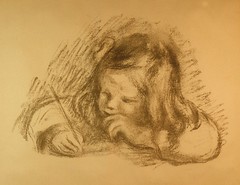
We have lithographs by Toulouse-Lautrec, Ronald Searle, and Auguste Renoir. There is a story about how we acquired them.
In November 1968 we returned from a trip to Europe and still had unused traveler's checks, a situation requiring immediate action. We decided on a stroll down Madison Avenue to find art work that might not exceed the value of the checks. (Hah!) We hadn't gone very far when I saw a drawing of a little girl in a shop window; it was love at first sight; I just had to have her. Mom agreed.
Then we noticed the name of the shop: Far Gallery. It was owned by Murray Roth and Herman Wechsler, friends of Paul Levenson, (married to Mom’s sister Anne) when he worked at Macy’s in New York, who had told us to look them up. We introduced ourselves, and the fun began: 1. The little “girl” was Claude Renoir, grandson of the famous artist; 2. The “drawing” was a lithograph by Claude's grandpa; 3. Our new friends brought out the Toulouse-Lautrecs; I almost exploded with excitement, travelers checks out of mind; 4. Mom saw the Searle lithograph (it is in her bedroom) and giggled with joy; 5. One of the owners then gave us a book, a veritable encyclopedia explaining the various ways in which prints are made. He autographed it; 6. We bought the Searle, the Renoir and two Toulouse-Lautrecs, arranged to have them framed and shipped with the book.
In the spring of 1969 the gallery tempted us with several lithographs; we opted for two more Toulouse-Lautrecs.
We have never tired of our selections; we think the frames and artwork are exquisite. They are a great joy; when Mom was more mobile, she would go through the living room during the day just to enjoy our gifts to ourselves. With a photographer’s eye, I marvel at the simplicity of lines and the unusual use of light by the artistes. The lithographs have not increased one whit in value since we bought them; no matter, we love them more and more as time passes.
Tuesday, March 1, 2011
The Wedding of Amelia and Gabe
I read this story at the wedding reception of Amelia Kahaney and Gabriel Sanders, Dec 27, 2005.
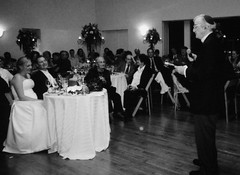
And it came to pass, Moishe came to the River Berezina. It was quiet and wide. And the birch trees fluttered and it was good. And Moishe said, “Here I shall build a mill and find a mate and we shall raise our family and it will be good.” And Moishe saw Doba and she was comely and Moishe took her as his wife. And they were fruitful. And they begat a bunch of kids from Fruma to Mashka. And they grew and they prospered. And it was good.
And it came to pass that the third son Hillel was alone one evening and a Cossack appeared. And they wrestled and Hillel was strong and defeated him. And the Cossack said, “What is your name?” and Hillel responded, “Hillel Zuckerman.” And the Cossack said, “From henceforth you will be known as Hillel Yachnovich.” And it was good.
And the Yachnovich sons left their home in Karanetz and went to America except Israel who stayed with Moishe and Doba. And the immigration officer said to the third son, “What is your name?” And he replied, “Hillel Yachnovich.” And the officer said, “That is not American enough. Henceforth, your name will be Harry Jackson.” And Hillel, named Harry, later called Peepa, did not like his new name but he bore his pain with dignity.
And every day of his life Harry, called Peepa, read the Forward or the Forvetz, a Yiddish newspaper published in the big city. And Harry, called Peepa, met Rose and she was comely and they wed. And it was good, and they begat Daniel and it was good. And they begat Evelyn, a lovely, sweet child and Harry, called Peepa, was happy. And every day Harry, called Peepa read the Forward or the Forvetz.
And Evelyn grew and she was comely and she met Moss and they wed, and they begat Phyllis and Debra and Mark and David. And they prospered. And Phyllis met Alan, and he was smitten by her beauty. And they wed and begat Amelia Batsheva. And Amelia was a comely child. And she looked at the world. And she wanted to try it all. And she tried tap dance and ballet and Israeli dance and modern dance. But it was not enough. And she tried the violin and the saxophone. But it was not right. And she was a Brownie and a camper and a skier but it was not good. And she tried acting and basketball and biking and teaching and writing but it meant nothing. And Amelia Batsheva said onto Phyllis, “Mother, I am growing and learning but it is empty. What am I missing?” And Phyllis said onto Amelia, “Hush, you must be patient.” And the time passed.
And Amelia became restless. And she said to Alan, “Father, is it time?” And Alan just smiled. And more time passed and Phyllis said onto Amelia, “Now is the time. You must go toward the rising sun to the metropolis called the Large Banana. There is your destiny.” And Amelia Batsheva said to Evy, “Grandma, I am going to the big city called the Large Banana to find happiness. Tell me, Grandma, how will I know how to find it?” And Evy whispered in her ear, “Ask thyself, W.W.P.D. What would Peepa do? Remember - he read the Forward or the Forvetz every day and there is your answer.”
And Phyllis prepared 37 peanut butter and jelly sandwiches. And she packed them for Amelia Batsheva and blessed her for her trip to the metropolis called the Large Banana. And Amelia Batsheva searched the city called the Large Banana for true happiness. She followed a large cloud by day and a pillar of fire by night. And she studied her books and searched. And she did her work and kept her eyes opened. And she played and she kept watch. And she was vigilant.
And she became discouraged. And she called Evy. “Grandma, what can I do? I have looked everywhere in the Large Banana. I cannot find my future.” And Evy said, “W.W.P.D. What Would Peepa DO: every day he read the Forward or the Forvetz published in the Large Banana.”
And Amelia took heart. And she looked in her backpack. And all the peanut-butter and jelly sandwiches were gone. And she looked up and a comely young man was before her. And he said, “I am Gabriel, your angel” and he gave her a newspaper. And it was the Forward, which was once called the Forvetz, which Peepa read every day. And Amelia smiled. “My Grandma said that Peepa knew that you will be my destiny.” And it was good.
L'CHAIM!
I read the above at the wedding reception of Amelia Kahaney and Gabriel Sanders. Gabe was on the staff of the Forward (also known as the Forvetz). Following is a note I received from them upon their return from their honeymoon:
Dramatis personae
- Moishe and Doba—great-great-grandparents of Amelia Moishe and Doba—great-great-grandparents of Amelia
- Hillel Zuckerman/Yachnovich, Harry Jackson/Peepa—great-grandfather of Amelia
- Evelyn—grandmother of Amelia
- Phyllis—mother of Amelia
And it came to pass, Moishe came to the River Berezina. It was quiet and wide. And the birch trees fluttered and it was good. And Moishe said, “Here I shall build a mill and find a mate and we shall raise our family and it will be good.” And Moishe saw Doba and she was comely and Moishe took her as his wife. And they were fruitful. And they begat a bunch of kids from Fruma to Mashka. And they grew and they prospered. And it was good.
And it came to pass that the third son Hillel was alone one evening and a Cossack appeared. And they wrestled and Hillel was strong and defeated him. And the Cossack said, “What is your name?” and Hillel responded, “Hillel Zuckerman.” And the Cossack said, “From henceforth you will be known as Hillel Yachnovich.” And it was good.
And the Yachnovich sons left their home in Karanetz and went to America except Israel who stayed with Moishe and Doba. And the immigration officer said to the third son, “What is your name?” And he replied, “Hillel Yachnovich.” And the officer said, “That is not American enough. Henceforth, your name will be Harry Jackson.” And Hillel, named Harry, later called Peepa, did not like his new name but he bore his pain with dignity.
And every day of his life Harry, called Peepa, read the Forward or the Forvetz, a Yiddish newspaper published in the big city. And Harry, called Peepa, met Rose and she was comely and they wed. And it was good, and they begat Daniel and it was good. And they begat Evelyn, a lovely, sweet child and Harry, called Peepa, was happy. And every day Harry, called Peepa read the Forward or the Forvetz.
And Evelyn grew and she was comely and she met Moss and they wed, and they begat Phyllis and Debra and Mark and David. And they prospered. And Phyllis met Alan, and he was smitten by her beauty. And they wed and begat Amelia Batsheva. And Amelia was a comely child. And she looked at the world. And she wanted to try it all. And she tried tap dance and ballet and Israeli dance and modern dance. But it was not enough. And she tried the violin and the saxophone. But it was not right. And she was a Brownie and a camper and a skier but it was not good. And she tried acting and basketball and biking and teaching and writing but it meant nothing. And Amelia Batsheva said onto Phyllis, “Mother, I am growing and learning but it is empty. What am I missing?” And Phyllis said onto Amelia, “Hush, you must be patient.” And the time passed.
And Amelia became restless. And she said to Alan, “Father, is it time?” And Alan just smiled. And more time passed and Phyllis said onto Amelia, “Now is the time. You must go toward the rising sun to the metropolis called the Large Banana. There is your destiny.” And Amelia Batsheva said to Evy, “Grandma, I am going to the big city called the Large Banana to find happiness. Tell me, Grandma, how will I know how to find it?” And Evy whispered in her ear, “Ask thyself, W.W.P.D. What would Peepa do? Remember - he read the Forward or the Forvetz every day and there is your answer.”
And Phyllis prepared 37 peanut butter and jelly sandwiches. And she packed them for Amelia Batsheva and blessed her for her trip to the metropolis called the Large Banana. And Amelia Batsheva searched the city called the Large Banana for true happiness. She followed a large cloud by day and a pillar of fire by night. And she studied her books and searched. And she did her work and kept her eyes opened. And she played and she kept watch. And she was vigilant.
And she became discouraged. And she called Evy. “Grandma, what can I do? I have looked everywhere in the Large Banana. I cannot find my future.” And Evy said, “W.W.P.D. What Would Peepa DO: every day he read the Forward or the Forvetz published in the Large Banana.”
And Amelia took heart. And she looked in her backpack. And all the peanut-butter and jelly sandwiches were gone. And she looked up and a comely young man was before her. And he said, “I am Gabriel, your angel” and he gave her a newspaper. And it was the Forward, which was once called the Forvetz, which Peepa read every day. And Amelia smiled. “My Grandma said that Peepa knew that you will be my destiny.” And it was good.
L'CHAIM!
I read the above at the wedding reception of Amelia Kahaney and Gabriel Sanders. Gabe was on the staff of the Forward (also known as the Forvetz). Following is a note I received from them upon their return from their honeymoon:
Dear Aunt Yvette and Uncle Dan—many, many thanks for your generous wedding gift. It is safely deposited in our “house fund” and as soon as soon as the housing bubble bursts we’ll be on the road to becoming house owners.
Dan, thanks to you especially for your generosity of spirit and the incredible speech you delivered for us on our wedding day. We have listened to it many times since and look forward to playing it for our children and our children’s children, It meant so much to have you at our wedding and we feel so lucky to have such an incredible family not just for big events like that but all the time. We’ll try to make a trip down to Houston soon so we can express our thanks in person. For now we hope you enjoy the photos of the big day! Yvette, we were so sorry you were not able to join us at the wedding but perhaps soon we can come with the video and it will be like doing it all over again. Thank you both for everything, always.
Much love, Amelia and Gabe
Thursday, February 3, 2011
Kvell time!
Bryan sent this email to Grandpa Dan:
Heya guys,
Just thought I'd drop you a line and let you know that Rick Tran who runs the Monologue Blog (http://soliloblog.com/) featured me this month talking about monologues.
This site is an amazing resource for actors.
I'm right on the main page, can't miss me!
It's a pretty cool interview, drop by if you have time.
Bryan Mordechai Jackson
Monday, January 31, 2011
Choice of Professions
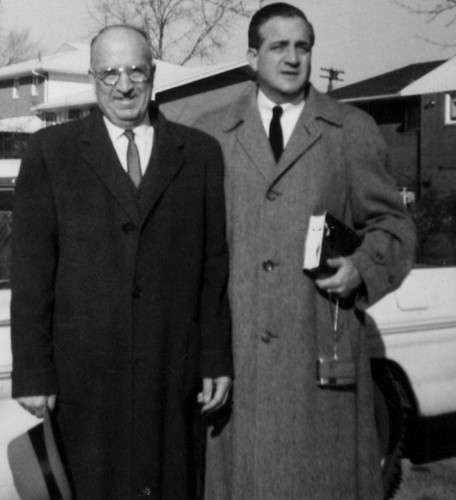
When I finished high school, Dad asked me about my plans.
I said, “I want to be a veterinarian.”
He said, “Why not be a real doctor?”
I said, “OK.” I went to college and medical school.
After my internship, I volunteered for the Army medical corps. I served in the South Pacific as a general medical officer with the 102nd Station Hospital, as a dermatologist with the 35th General hospital, and as an anesthetist with the 58th Evac Hospital. When I returned home, I knew I wanted more medical training. The experience as an anesthetist had been so interesting that I applied for a residency in anesthesiology at Charity Hospital in New Orleans, whose chief, John Adriani, mentored the best residency program in the States. It was his books on the chemistry and physiology of anesthesia that I referred to while learning on-the-job as an anesthetist in surgery at the 58th Evac.
I liked Dr. Adriani immediately. We met in the doctors’ dressing room of the surgical suite; he was in scrubs and we sat on benches and chatted. He was in no hurry to end my interview and proceeded to tell me why he had given up his surgical training to become an anesthesiologist: after he had finished his residency in general surgery, he didn’t feel capable of doing more than appendectomies and repairs of hernias. He knew he was better than that which led him to learn about anesthetics and become the medical profession’s leader in that specialty. I left him, excited and ready to learn from him.
When Dad asked me what I was going to do now that I was home from the army, I said I was going to be an anesthesiologist. He said, “You ought to be a heart doctor and take care of people.” I said I would. I canceled the residency in anesthesiology, took residencies in chest and internal medicine, and eventually became an internist.
Now, some fifteen years after I’ve retired from the practice of medicine, I’ve been thinking: What would my life have been as a veterinarian? What would my life have been if I had become an anesthesiologist?
Those are interesting questions. That I still remember the episode after 65 years emphasizes the impact of Dad’s influence on my life. It also points out my failure to have a strong feeling about my right to make my own decisions. I was able to accept the change in my goal; I became an internist with a strong interest in diseases of the lung. I cared for my patients and took good care of them. I was a good role model for my sons; all three became healers, (two physicians and a psychotherapist) and excellent ones, too. I made a “good” living for our family.
How would Dad have reacted if I ignored his wish that I become a “heart doctor” and train to be a vet or an anesthesiologist? He would have been disappointed, I know, but he would have accepted my decision and remained interested and supportive. This recalls my decision to join a reform congregation rather than a conservative or orthodox one that I knew Dad expected when we moved to Houston. To better understand my choice, Dad spoke with Robert Kahn, our rabbi at Temple Emanu El, at a Friday evening service. I don’t know what was said during their brief chat, but whatever it was, it lifted the load from Dad’s heart about my choice. The matter never came up again. Similarly, if I had chosen veterinarian medicine or anesthesiology, I believe Dad would have had a talk with my mentor to gain some insight into my work and, so, would have been more at ease about my future and even actively supported me.
As a vet or as a “passer of gas” as anesthesiologists are accused of being, would I have seen myself as having diminished stature in the medical or professional community? Would I feel I were a slacker, one having less ambition if I were to choose a profession that required less training, less expense, less study, less training than a “heart doctor?” That would be a side issue that I know I would have to confront; it would part of my agenda to be the best of my choice, to explore all new ideas, all frontiers so that I would stand out in my own mind. No matter my choice, I knew Yvette would support me and defend me and make my professional and home life the best for both of us.
If I had chosen to be a vet or an anesthetist, what kind of doctor would I have been? I am drawn to animals and I’m certain I would have loved taking care of them. Loving my patients and wanting them to be well would have been a combination of attitudes that would have made me happy in my work. As to being an anesthetist, I remember, to this day, how much I wanted to be mentored by Adriani. He was thoroughly at ease, had no airs about him, like a good father, a father figure who would never be a tyrant, who would want his house staff to be the best because they respected him, wanted to learn, and wanted to please him. So, I knew that either choice of medicine I had in mind to pursue was really going to be right for me.
I did become an internist though not the cardiologist that Dad aspired for me. With time my practice evolved into seeking out my patients’ inner needs as well as their physical needs. My combination of interest in both physical and emotional matters was deeply satisfying for me; I was successful in learning to take care of the “whole” patient, the goal of a true physician.
Sunday, January 16, 2011
Evy's Birthday Story
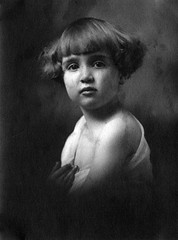
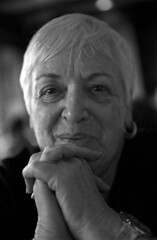
This story was read at Evy’s 80th birthday party in San Diego.
All of you are familiar with the story of Evy’s coming to California after Jackson’s Shoe Stores went bankrupt in the recession of the 60s. She got a job as a saleslady in a shoe store in Downy and soon after became the top seller among all the clerks. She expected to be made manager but the position went to the boss’s son. That was unfair and a signal that her efforts were not appreciated. She gave 2 weeks notice and turned her interest and skill to playing bridge. Now she was going to have fun.
She played, studied, and dreamed bridge. With her facility with numbers and her competitive spirit she became a top-grade player. She soon became a Life Master and was in demand as a partner at her bridge club. A top male player confided to her that she was the best woman player in southern California. Bridge became her life.
She visited us in Houston and played with us at Fuzz and Sandy’s house and at our bridge club. We caught fire and her enthusiasm to teach us was matched by our wish to learn.
Yes, that is all very interesting, but remember we are celebrating her birthday so now I want to talk about the actual event of her birth on May 20, 1922. To do that I have looked up Dad’s description in his oral history. I am going to read from it:
Saturday, May 20. I opened the store (a general store in Rosston, Pennsylvania) about 7 in the morning. I hung up my post office sack near the railroad to wait for the next Buffalo Flyer to catch it and in exchange, to throw one out for us.
Ann Duff that worked for us at that time suddenly called me to the telephone. I ran up the steps into the store and I answered the call. ‘Mazel Tov, Mazel Tov!’ and I hear my father-in-law’s voice, ‘A beautiful little girl, a dear little baby!’ I stood there listening to his words and I am so excited that I can’t answer and I am thinking, a little girl? Is it possible? Is it really true? Maybe because they knew that all the time we talked and planned and dreamed about the little girl, right off the bat they are telling me there is a little girl.
I am so happy! I am holding back tears of joy and I did not wait to show how happy I feel inside of me but I grabbed the Buick that we had and I am driving to see my vibel. I really do not want to say that I am ‘flying’ but this is the way I was driving to Pittsburgh that Saturday morning. I was drunk from happiness and in this drunken state God knows I will run over somebody! My father-in-law and my mother-in-law meet me at their door and they are kissing me and wishing me Mazel Tov, Mazel Tov! Wow! Is this a little girl, what a baby doll! I grabbed a bouquet of flowers and I am running to the hospital and I find my Raisel in bed, all dolled up and full of happiness and my Vibel says to me, ‘See my dear, we have a little girl, just like we wanted. A beautiful little baby and we are going to call her Eta Hudel, Evelyn Harriet.’ Even the name she planned out, but I am so happy that I do not care that she plans this whole thing out herself and it really does not bother me.
I waited there a little while and a nurse came and said, ‘Mr. Jackson, the doctor would like to see you.’ My heart begins to pound. I haven’t had a chance to see my baby and why does the doctor want to see me? I say to the nurse, ‘Is anything wrong?’ She does not say anything. My mouth is dry. I am feeling faint. Then I see that she takes me to the doctor and he is holding my baby. He is smiling and I feel relieved and I am sure that everything will be for the best.
He puts my Eta Hudel on a little table and I see my sweet baby. He says, ‘Mr. Jackson, I need your help with a little problem. It is nothing to worry about. I want you to hold your baby’s arm while I try to open her hand.’ I am loving to hold my baby’s arm but I do not understand. Then the doctor says, ‘I want to open her hand. It is closed tightly and I must open it.’ I watch him. Very gently he takes one tiny finger and opens it and then another finger and then another finger. The hand is open and there in that little hand, in my baby’s angel hand is---is the tiniest deck of cards I have ever seen!
Wednesday, January 5, 2011
Danisms
When our sons were in training or in practice, I often met with them over coffee to give them my thoughts on patients and my philosophy about taking care of them. Here is what they called "Danisms:"
- The doctor is the medicine that gets people well.
- Ten percent of your patients take up 90% of your time.
- Don't be in a hurry to give your patient a bad diagnosis.
- Diseases are easy; people are difficult.
- Listen to the patient and you will hear the diagnosis and often the treatment.
- Difficult patients put your kids through college.
- Sometimes the only satisfaction you will get from patients who aggravate you is when they pay their bills.
- Your most important diagnostic tool is your ear.
- When patients love you, they will forgive your mistakes.
- The patient always knows the truth.
- Depression is the most common disease in your practice.
- The most valuable tool in your examining room is your chair--sit in it and listen.
Sunday, December 12, 2010
Lombardi!
(This is from a note Grandpa sent yesterday.)
Just finished watching HBO piece on Vince Lombardi. It reminded me when we were watching the final game of the NFL season Dec 31, 1967 at the Sandfield home on Wentwood in Dallas. The Cowboys were leading the Packers 17-14. The Packers were at the Cowboys goal line but tried twice to put it over without success. With seconds remaining on 4th down Bart Starr put the ball over on a quarterback sneak. As he did, I yelled, "Yea!" at the top of my voice. The room fell quiet; I had forgotten I was in a room of Cowboy fans and my hosts.
Just finished watching HBO piece on Vince Lombardi. It reminded me when we were watching the final game of the NFL season Dec 31, 1967 at the Sandfield home on Wentwood in Dallas. The Cowboys were leading the Packers 17-14. The Packers were at the Cowboys goal line but tried twice to put it over without success. With seconds remaining on 4th down Bart Starr put the ball over on a quarterback sneak. As he did, I yelled, "Yea!" at the top of my voice. The room fell quiet; I had forgotten I was in a room of Cowboy fans and my hosts.
Tuesday, December 7, 2010
A Point of view
(Keith rescued this entry from 'draft' status. It was originally created in 2009.)
Last night Yvette and I watched a movie. Afterward I turned the tube off and as I often do, said, "Let's talk." It's a way for her to talk about anything that comes to mind; it can be our children, the women who help take care of us, the next ballet program, or about how we met.
Last night Yvette and I watched a movie. Afterward I turned the tube off and as I often do, said, "Let's talk." It's a way for her to talk about anything that comes to mind; it can be our children, the women who help take care of us, the next ballet program, or about how we met.
We talked for a while and then I told her," I've been sweating. I need to shower. I stink." She sniffed me, then shrugged her shoulders, "I thought all men smelled that way."
Beaver County Times: Doc from area wonders about air
Gino Piroli has been corresponding with Grandpa and wrote an article about him. Check it out...
Beaver County Times: Doc from area wonders about air
Beaver County Times: Doc from area wonders about air
Monday, November 8, 2010
Your new (old) blogger
I’m Dr. Dan Jackson, your new resident blogger. Let me tell you about myself.
I was born 92 years ago in Aliquippa, Pennsylvania, a small steel mill town on the Ohio River. I went to school at Geneva College, then to St. Louis University Medical School where I got my degree in 1941.
After that it was an internship at the Allegheny Hospital in Pittsburgh, three and a half years in the Army, mostly in the South Pacific, and residencies at Cleveland City Hospital and the Veteran’s Administration Hospital in New Orleans.
Our family moved to Houston on June 30, 1949 where the Texas Medical Center was just beginning to take shape. I opened my practice of internal medicine in a small office at the corner of Rosalie and San Jacinto across from the old Methodist Hospital. I moved to the Medical Center in 1954.
In 1976 I was delighted to be joined by my son Dr. Richard Jackson; we named our new organization, Associates in Medicine. Shortly after that we moved to the Scurlock Towers where the group has grown to its present size. It has a fine reputation for outstanding medical care.
I retired in 1995. I spend my time playing bridge, writing, reading, and watching birds and squirrels in my back yard.
I was born 92 years ago in Aliquippa, Pennsylvania, a small steel mill town on the Ohio River. I went to school at Geneva College, then to St. Louis University Medical School where I got my degree in 1941.
After that it was an internship at the Allegheny Hospital in Pittsburgh, three and a half years in the Army, mostly in the South Pacific, and residencies at Cleveland City Hospital and the Veteran’s Administration Hospital in New Orleans.
Our family moved to Houston on June 30, 1949 where the Texas Medical Center was just beginning to take shape. I opened my practice of internal medicine in a small office at the corner of Rosalie and San Jacinto across from the old Methodist Hospital. I moved to the Medical Center in 1954.
In 1976 I was delighted to be joined by my son Dr. Richard Jackson; we named our new organization, Associates in Medicine. Shortly after that we moved to the Scurlock Towers where the group has grown to its present size. It has a fine reputation for outstanding medical care.
I retired in 1995. I spend my time playing bridge, writing, reading, and watching birds and squirrels in my back yard.
Monday, October 4, 2010
Readin' and writin'
When I was a student at Highland Elementary school in Aliquippa, one of my teachers was Ms Crawford, a tall, vivacious red-head. She taught us how to open new school books---hold the book with its spine on the desk and gradually strip the covers and pages away on each side till the pages and covers lie flat on the desk. And she said, "Light should come from the left on the book you are reading or on the paper where you are writing."
We did not question her wisdom; we were so excited to learn to read and write that we did as we were told.
About four years ago, I wrote a short story about my time at Highland and the business of making sure which side the light came from. Evy and I made a trip to Rosston, where the family lived when she was born and to Aliquippa where we had rounded out our elementary education. By then, of course, Highland was only a weed-filled lot. Still, the question about the importance of having light come from the left remained.
This morning, eighty four years after Ms Crawford and Highland, I got my answer. After breakfast, I began the crossword puzzle in the morning paper; light came from the window at my right. As I wrote (right-handed), there was an annoying shadow on the paper. I asked Lucy to turn the ceiling light on. The light went on in my head,too: WHEN THE LIGHT COMES FROM THE RIGHT, THERE IS A SHADOW ON THE PAPER MADE BY MY HAND AND PENCIL. That shadow makes it hard for me to see what I'm writing. So simple.
More new questions: why did it take me eighty four years to figure that out? And did the explanation for writing hold true for reading as Ms Crawford taught us? And what would left-handed children do?
We did not question her wisdom; we were so excited to learn to read and write that we did as we were told.
About four years ago, I wrote a short story about my time at Highland and the business of making sure which side the light came from. Evy and I made a trip to Rosston, where the family lived when she was born and to Aliquippa where we had rounded out our elementary education. By then, of course, Highland was only a weed-filled lot. Still, the question about the importance of having light come from the left remained.
This morning, eighty four years after Ms Crawford and Highland, I got my answer. After breakfast, I began the crossword puzzle in the morning paper; light came from the window at my right. As I wrote (right-handed), there was an annoying shadow on the paper. I asked Lucy to turn the ceiling light on. The light went on in my head,too: WHEN THE LIGHT COMES FROM THE RIGHT, THERE IS A SHADOW ON THE PAPER MADE BY MY HAND AND PENCIL. That shadow makes it hard for me to see what I'm writing. So simple.
More new questions: why did it take me eighty four years to figure that out? And did the explanation for writing hold true for reading as Ms Crawford taught us? And what would left-handed children do?
Wednesday, September 15, 2010
Brief encounter
Today I went to the 2nd Michael E. DeBakey lecture. The speaker was a charming Egyptian who does research in London, has been knighted for his work and also works to help certain African groups in their struggle to better themselves.He spoke about heart disease and its treatment with implanting a pump to help the heart pump better. It was more than that---dealing at a microscopic level, at a cellular level; in terms that I knew nothing about.
Before the talk began (the place was full) Mrs DeBakey came in; Rob introduced her to the speaker, then to most of us in the front rows, including me..
When the session was over, I remained seated till every one was streaming out. Mrs. DeBakey came over to me. She speaks with an accent (German), which made my understanding her much more difficult. When she asked me where I lived, I told her about our moving to Houston in '49 and how much her husband had done for Methodist, Baylor, the Medical Center, Houston, the field of medicine,and on and on. I said I was present when medical history driven by her husband was being made and I considered it a honor to watch.She thanked me.
Before the talk began (the place was full) Mrs DeBakey came in; Rob introduced her to the speaker, then to most of us in the front rows, including me..
When the session was over, I remained seated till every one was streaming out. Mrs. DeBakey came over to me. She speaks with an accent (German), which made my understanding her much more difficult. When she asked me where I lived, I told her about our moving to Houston in '49 and how much her husband had done for Methodist, Baylor, the Medical Center, Houston, the field of medicine,and on and on. I said I was present when medical history driven by her husband was being made and I considered it a honor to watch.She thanked me.
Monday, August 16, 2010
Memorial for Irv
Irv was my best friend. We first met when he, Sherry, and Karen visited us shortly after they moved to Houston in 1957.
That visit had an element of who was going to be the big dog in our relationship. Somehow, we got around to talking about anorexia nervosa. That was the kind of problem that a child psychiatrist would take care of; that was Irv’s specialty. So I asked him, “Have you seen the latest about anorexia nervosa in the Proceedings of the Mayo Clinic? ”
He paused and admitted, “No, I haven’t.”
I dashed back to my study, found the article, and showed it to him. The game had started. Score: Dan--one, Irv--zero.
That didn’t faze Irv: in fact, we developed a genuine friendship. When I saw all the books he read, all the magazines he subscribed to, all the journals piled up on his coffee table, all the meetings he attended, all the countries he visited, I surrendered. No contest.
Our friendship was nourished by the closeness of Yvette and Sherry. They talked every day by phone. Sometimes twice a day, week after week, month after month. Finally Irv asked, “What do they talk about? “
I shrugged my shoulders, “Beats me.”
Then came the two-for-one phase of our lives. Houston’s restaurants offered coupons giving two meals for the price of one. The four of us were children of the Great Depression, so we attacked the offer of 2 for 1 with gusto. The downside was that most of the restaurants were one star or less. No matter, we filled our stomachs and at ½ price. If the food wasn’t good, the price was.
At about that time Irv and Yvette went on diets to combat their coronary artery disease. Result; fish, vegetables, fresh vegetables, more fish, and more vegetables. But we were saving money and eating healthy.
Then came the event that literally changed my life. Irv heard that Paul Gittings Jr of the portrait photography studio was giving a 10-week course on photography. Irv invited me to go with him every Wednesday night for 10 weeks.
I had been mildly interested in the camera since I had been bar mitzvah. Most of you don’t know that many years ago Eastman Kodak gave every Jewish boy a box camera when he reached his 13th birthday. Clever marketing: the lucky boy got a camera but had to buy film, then pay for having it processed and printed- a gold mine for Kodak. The course by Gittings reawakened my interest in photography and ever since has been important in adding life to my years.
Irv and I often spent Saturday mornings doing nature photography. I photographed flowers and leaves; Irv took pictures of me as I photographed.
Irv was a profound source of advice for me. I knew he was wise about life and helping people. Through the years when I called him, no matter the time of day or a weekday or weekend, he made himself available. When I called, he would respond, “Come over.” He was never judgmental; he gave me solutions to perplexing problems. I knew I could trust him. And he enjoyed advising me about problems that he and I shared as aging males and good friends.
In a way I could never repay him for what he did for me. I tried laughing at his sense of humor; well, I really didn’t laugh, I groaned. And it wasn’t humor; it was puns, awful puns.
For his birthday I invited Irv to our house for lunch. We talked, ate a bowl of hearty soup, sipped red wine, and ate chocolate birthday cake. We agreed we still had all our marbles. As I dropped him off at his house, he glanced at his watch. He noted that he had stayed longer than usual. He asked, “What shall I tell Sherry?”
I suggested “Tell her we’ve been talking about her.” He thanked me profusely. Hey, what are friends for?
Who will I send emails to, who will I invite for lunch and conversation? Who will I sing Happy Birthday to? Who will I forward sexy e-mails to? Who will I talk to about my problems?
Irv, I do miss you.
That visit had an element of who was going to be the big dog in our relationship. Somehow, we got around to talking about anorexia nervosa. That was the kind of problem that a child psychiatrist would take care of; that was Irv’s specialty. So I asked him, “Have you seen the latest about anorexia nervosa in the Proceedings of the Mayo Clinic? ”
He paused and admitted, “No, I haven’t.”
I dashed back to my study, found the article, and showed it to him. The game had started. Score: Dan--one, Irv--zero.
That didn’t faze Irv: in fact, we developed a genuine friendship. When I saw all the books he read, all the magazines he subscribed to, all the journals piled up on his coffee table, all the meetings he attended, all the countries he visited, I surrendered. No contest.
Our friendship was nourished by the closeness of Yvette and Sherry. They talked every day by phone. Sometimes twice a day, week after week, month after month. Finally Irv asked, “What do they talk about? “
I shrugged my shoulders, “Beats me.”
Then came the two-for-one phase of our lives. Houston’s restaurants offered coupons giving two meals for the price of one. The four of us were children of the Great Depression, so we attacked the offer of 2 for 1 with gusto. The downside was that most of the restaurants were one star or less. No matter, we filled our stomachs and at ½ price. If the food wasn’t good, the price was.
At about that time Irv and Yvette went on diets to combat their coronary artery disease. Result; fish, vegetables, fresh vegetables, more fish, and more vegetables. But we were saving money and eating healthy.
Then came the event that literally changed my life. Irv heard that Paul Gittings Jr of the portrait photography studio was giving a 10-week course on photography. Irv invited me to go with him every Wednesday night for 10 weeks.
I had been mildly interested in the camera since I had been bar mitzvah. Most of you don’t know that many years ago Eastman Kodak gave every Jewish boy a box camera when he reached his 13th birthday. Clever marketing: the lucky boy got a camera but had to buy film, then pay for having it processed and printed- a gold mine for Kodak. The course by Gittings reawakened my interest in photography and ever since has been important in adding life to my years.
Irv and I often spent Saturday mornings doing nature photography. I photographed flowers and leaves; Irv took pictures of me as I photographed.
Irv was a profound source of advice for me. I knew he was wise about life and helping people. Through the years when I called him, no matter the time of day or a weekday or weekend, he made himself available. When I called, he would respond, “Come over.” He was never judgmental; he gave me solutions to perplexing problems. I knew I could trust him. And he enjoyed advising me about problems that he and I shared as aging males and good friends.
In a way I could never repay him for what he did for me. I tried laughing at his sense of humor; well, I really didn’t laugh, I groaned. And it wasn’t humor; it was puns, awful puns.
For his birthday I invited Irv to our house for lunch. We talked, ate a bowl of hearty soup, sipped red wine, and ate chocolate birthday cake. We agreed we still had all our marbles. As I dropped him off at his house, he glanced at his watch. He noted that he had stayed longer than usual. He asked, “What shall I tell Sherry?”
I suggested “Tell her we’ve been talking about her.” He thanked me profusely. Hey, what are friends for?
Who will I send emails to, who will I invite for lunch and conversation? Who will I sing Happy Birthday to? Who will I forward sexy e-mails to? Who will I talk to about my problems?
Irv, I do miss you.
Saturday, August 7, 2010
On the Dummy Line - with NEW lyrics
(posting by Keith)
For those of us who travelled any distance by car with Dan and Yvette, the song "On the Dummy Line" is well known. We've memorized three or four verses about Farmer Jones, my girl in Mobile, and some other characters. It gives us a warm and familiar feeling when we hear it or sing it. Somehow Rachael and I were talking about the song and we thought we should do some research to see if we could find more verses. Success! Rachael found a bunch. They are shown below for your pleasure, but I have to make a suggestion. I've found that they just don't work very well when read silently in my head. They were about eight times funnier when Rachael was reading them out loud to me. So I suggest printing this posting and finding a willing family member to share the fun of reading them aloud. I should also mention that some of them are rated PG, maybe even PG13.
Special thanks to Rachael for assembling the list.
On the dummy line,
On the dummy line,
Rain or shine
I'll pay my fine
Rain or shine
I'll pay my fine
Ridin' ridin' ridin' on the dummy, dummy line.
I saw a snail
Go whizzing past;
The guy beside me said,
"This train is fast!"
Said I, "Old man,
That might be true,
But the question is,
What's it fast compared to?"
I said to the brakeman,
"Can't you speed up a bit?"
Said he, "You can walk
If you don't like it."
Said I, "Mr. Brakeman,
I'd like to take your dare,
But the folks don't expect me
Til the train gets there."
There was a doctor
By the name of Beck
He fell in the well
And he broke his neck;
It served him right,
As you may own;
He should attend the sick
And leave the well alone!
Farmer Jones,
He went out in a boat,
The boat turned over,
And we threw him a rope;
Said Farmer Jones,
"Well, I can't swim,
But I'll be drowned first
Afore I'll be roped in!"
A little boy
On his way home from school
Saw a dollar bill
At the foot of a mule;
He stooped right down
Just as sly as a fox,
You can see him at the hospital
Till seven o'clock.
I once had a girlfriend
Down in Mobile,
She had a face
Like a lemon peel.
She had a wart
At the end of her chin;
She said it was a dimple,
But a dimple turns in!
Little Willy was a good Boy Scout
He gouged his sister's eyeballs out.
When his mother said, "Willy, stop,'
He jumped on them to make them pop.
Little Willy at a passing gent
threw a bag of wet cement.
Then Willy said, "when you dry
you're sure to be a real hard guy."
Little Willy was full of gore
he nailed his sister to the door.
Said Willy's mother, in a voice so faint:
"Willy, please -- you'll scratch the paint!"
Little Willy found some dynamite,
couldn't understand it quite.
Curiosity never pays –
it rained Willy seven days!
Little Willie Jones fell down the elevator
There they found him six months later
They held their noses and said, "Gee, whiz,
What a spoiled child our little Willie is."
I looked out my window so early one morn
There was a tramp who was munching the lawn
I said "My good man, if you're after a snack
The grass is much longer around the back."
I called on my girl, her name was Miss Brown
She was having a shower and couldn't come down
I said "Slip on something, you'd better be quick"
She slipped on the soap and, my word, she was quick
Mary the milkmaid was milking the cow
The trouble with Mary, she didn't know how
The farmer came out and he gave her the sack
So she turned the cow over and poured the milk back
I woke up in the morning and spied upon the wall,
The bedbugs and the roaches were having a game of ball,
The score was 19-20, the roaches were ahead,
The bedbugs hit a homerun and knocked me out of bed.
the other day i saw a bear
a great big bear oh way up there
he looked at me, i looked at him
he sized up me, i sized up him
he said to me, "why don't you run?
i see you ain't got any gun"
and so i ran away from there
and right behind me was that bear
ahead of me there was a tree
a great big tree oh lucky me
and so i jumped into the air
and missed that branch oh way up there
now don't you fret and don't you frown
i caught that branch on the way back down
the moral of my story is
don't talk to bears in tennis shoes
Little Willy coming home from school
Spied a half a dollar at the foot of a mule
Stooped down to pick it up, quiet as a mouse
Funeral tomorrow at little Willy's house!
Little birdie in the sky
Dropped some whitewash in my eye
Says I to me; says me to I
"I'm sure glad that cows can't fly!"
There was a boy by the name of Jack
Pitched his tent on a railroad track
Midnight express came around the bend
What kind of flowers did you send?
There once was a hunter, his name was O'Hare
He was chased by a grizzly bear
The people all thought he was out of his mind
Running down the street with a bear behind!
There was an old witch by the name of Nan
Who tried to pass as a good humor man
Couldn't fool the kids, they all stayed home -
They would not buy from an ice cream crone.
For those of us who travelled any distance by car with Dan and Yvette, the song "On the Dummy Line" is well known. We've memorized three or four verses about Farmer Jones, my girl in Mobile, and some other characters. It gives us a warm and familiar feeling when we hear it or sing it. Somehow Rachael and I were talking about the song and we thought we should do some research to see if we could find more verses. Success! Rachael found a bunch. They are shown below for your pleasure, but I have to make a suggestion. I've found that they just don't work very well when read silently in my head. They were about eight times funnier when Rachael was reading them out loud to me. So I suggest printing this posting and finding a willing family member to share the fun of reading them aloud. I should also mention that some of them are rated PG, maybe even PG13.
Special thanks to Rachael for assembling the list.
On the dummy line,
On the dummy line,
Rain or shine
I'll pay my fine
Rain or shine
I'll pay my fine
Ridin' ridin' ridin' on the dummy, dummy line.
I saw a snail
Go whizzing past;
The guy beside me said,
"This train is fast!"
Said I, "Old man,
That might be true,
But the question is,
What's it fast compared to?"
I said to the brakeman,
"Can't you speed up a bit?"
Said he, "You can walk
If you don't like it."
Said I, "Mr. Brakeman,
I'd like to take your dare,
But the folks don't expect me
Til the train gets there."
There was a doctor
By the name of Beck
He fell in the well
And he broke his neck;
It served him right,
As you may own;
He should attend the sick
And leave the well alone!
Farmer Jones,
He went out in a boat,
The boat turned over,
And we threw him a rope;
Said Farmer Jones,
"Well, I can't swim,
But I'll be drowned first
Afore I'll be roped in!"
A little boy
On his way home from school
Saw a dollar bill
At the foot of a mule;
He stooped right down
Just as sly as a fox,
You can see him at the hospital
Till seven o'clock.
I once had a girlfriend
Down in Mobile,
She had a face
Like a lemon peel.
She had a wart
At the end of her chin;
She said it was a dimple,
But a dimple turns in!
Little Willy was a good Boy Scout
He gouged his sister's eyeballs out.
When his mother said, "Willy, stop,'
He jumped on them to make them pop.
Little Willy at a passing gent
threw a bag of wet cement.
Then Willy said, "when you dry
you're sure to be a real hard guy."
Little Willy was full of gore
he nailed his sister to the door.
Said Willy's mother, in a voice so faint:
"Willy, please -- you'll scratch the paint!"
Little Willy found some dynamite,
couldn't understand it quite.
Curiosity never pays –
it rained Willy seven days!
Little Willie Jones fell down the elevator
There they found him six months later
They held their noses and said, "Gee, whiz,
What a spoiled child our little Willie is."
I looked out my window so early one morn
There was a tramp who was munching the lawn
I said "My good man, if you're after a snack
The grass is much longer around the back."
I called on my girl, her name was Miss Brown
She was having a shower and couldn't come down
I said "Slip on something, you'd better be quick"
She slipped on the soap and, my word, she was quick
Mary the milkmaid was milking the cow
The trouble with Mary, she didn't know how
The farmer came out and he gave her the sack
So she turned the cow over and poured the milk back
I woke up in the morning and spied upon the wall,
The bedbugs and the roaches were having a game of ball,
The score was 19-20, the roaches were ahead,
The bedbugs hit a homerun and knocked me out of bed.
the other day i saw a bear
a great big bear oh way up there
he looked at me, i looked at him
he sized up me, i sized up him
he said to me, "why don't you run?
i see you ain't got any gun"
and so i ran away from there
and right behind me was that bear
ahead of me there was a tree
a great big tree oh lucky me
and so i jumped into the air
and missed that branch oh way up there
now don't you fret and don't you frown
i caught that branch on the way back down
the moral of my story is
don't talk to bears in tennis shoes
Little Willy coming home from school
Spied a half a dollar at the foot of a mule
Stooped down to pick it up, quiet as a mouse
Funeral tomorrow at little Willy's house!
Little birdie in the sky
Dropped some whitewash in my eye
Says I to me; says me to I
"I'm sure glad that cows can't fly!"
There was a boy by the name of Jack
Pitched his tent on a railroad track
Midnight express came around the bend
What kind of flowers did you send?
There once was a hunter, his name was O'Hare
He was chased by a grizzly bear
The people all thought he was out of his mind
Running down the street with a bear behind!
There was an old witch by the name of Nan
Who tried to pass as a good humor man
Couldn't fool the kids, they all stayed home -
They would not buy from an ice cream crone.
Sunday, June 27, 2010
Short story of my life
When I finished high school, Dad asked me about my plans.
I said, “I want to be a veterinarian.”
He said, “Why not be a real doctor?”
“I said, ‘OK’.” I went to college and medical school.
After my internship, I joined the Army medical corps. I served in the South Pacific as a general medical officer and a dermatologist and as an anesthetist with the 58th Evac Hospital. When I returned home, I knew I wanted more medical training. The experience as an anesthetist had been so interesting that I applied for a residency in anesthesiology. I was accepted at Charity Hospital in New Orleans, probably the best residency program in the States.
When Dad asked me what I was going to do now that I was home from the army, I said I was going to be an anesthesiologist. He said, “You ought to be a heart doctor and take care of people.” I said I would.
I canceled the residency in anesthesiology, took residencies in chest and medicine, and eventually became an internist.
Now, about fifteen years after I’ve retired from the practice of medicine, I’ve been thinking: What would my life have been as a veterinarian? What would my life have been if I had become an anesthesiologist?
Interesting questions.
I said, “I want to be a veterinarian.”
He said, “Why not be a real doctor?”
“I said, ‘OK’.” I went to college and medical school.
After my internship, I joined the Army medical corps. I served in the South Pacific as a general medical officer and a dermatologist and as an anesthetist with the 58th Evac Hospital. When I returned home, I knew I wanted more medical training. The experience as an anesthetist had been so interesting that I applied for a residency in anesthesiology. I was accepted at Charity Hospital in New Orleans, probably the best residency program in the States.
When Dad asked me what I was going to do now that I was home from the army, I said I was going to be an anesthesiologist. He said, “You ought to be a heart doctor and take care of people.” I said I would.
I canceled the residency in anesthesiology, took residencies in chest and medicine, and eventually became an internist.
Now, about fifteen years after I’ve retired from the practice of medicine, I’ve been thinking: What would my life have been as a veterinarian? What would my life have been if I had become an anesthesiologist?
Interesting questions.
Saturday, June 12, 2010
Recalling musical history
My friend Joan and I were talking music. Somehow we got around to the Mendelssohn Violin Concerto. I flashed to an incident that occurred about 50 years ago: Fredell Lack was performing that piece with the Houston symphony. They were near the end when Fredell stopped, the orchestra stopped, and Fredell, knowing they were not playing together, gave the conductor and orchestra instructions where to start again. This time they ended together.
Wondering if my memory was playing tricks on me, I wrote to Fredell who was a friend of many years. Here is her response:
"It was a nice surprise to hear from you.....Your memory serves you right. That concert you remembered that I played with the Houston Symphony and with Leopold Stokowski was a nightmare for me.The maestro got lost, the orchestra stopped playing, and I was playing alone. I suggested to his Imperial Highness that we return to the beginning of the last movement, and this time the orchestra followed ME. He was furious, and refused to bow with me. It's a famous story.
Fondly, Fredell and Ralph"
Wondering if my memory was playing tricks on me, I wrote to Fredell who was a friend of many years. Here is her response:
"It was a nice surprise to hear from you.....Your memory serves you right. That concert you remembered that I played with the Houston Symphony and with Leopold Stokowski was a nightmare for me.The maestro got lost, the orchestra stopped playing, and I was playing alone. I suggested to his Imperial Highness that we return to the beginning of the last movement, and this time the orchestra followed ME. He was furious, and refused to bow with me. It's a famous story.
Fondly, Fredell and Ralph"
Subscribe to:
Posts (Atom)